Showing posts with label Sustainable Design. Show all posts

Thursday, 9 September 2010

Design Can Change.....FACT(s)

Some may ask why designers should be concerned with change. Isn't this the domain of elected officials and social groups? The designers (us) are so close to the issue that we are uniquely positioned to make a difference.......

As designers, we can choose to make a great difference.


STUDENT: Sustainability is becoming the most important addition to the creative brief. As much as we might not like to admit it, many designers aren't prepare for this. We've been busy working on our skills, learning about brands, adapting to new technology, ans keeping our studios alive during some lean times.

As a student, we have a great opportunity to enter our studios with skills that we not possess while differentiating ourselves from our classmates.

Come summer, we may well be applying for our internships. When the flurry of applications land on the desks of creative directors, ours may look like one of the new breed, or just like all the others.


Anna garforth: mossenger.


UK designer Anna Garforth has gone above and beyond green-washing to create a truly biodegradable and all natural graffiti. With “Mossenger” she’s created living, breathing, and sustainable outdoor art. Fashioned from a common moss that thrives on brick walls, she took a quote from poet Eleanor Stevens, carved the moss, and glued it to the wall with a mix of totally biodegradable ingredients.

As the moss grows it will begin to spread out and the words themselves will literally spread themselves, in all their green glory, across the wall and melt into a field of green. Part of an on-going project experimenting with public space and street art, I’m majorly interested to see what Garforth will be up to next. Perhaps the next lines of the poem will strategically find themselves on walls across the city?
Green Conscious Graphic Designers/Studios featured in IdN Magazine:The Eco-Issue (172)


999 Design | Airside | Anna Garforth | Becky Redman | Ciclus | David Graas | De Designpolitie | Design by Mar | Giles Miller | i29 | Justin Gignac | Marco Martins | Narani Kannan | Paul Woods | Philippe Intraligi | Postcarden | Sanjeev Shankar | The Design Office | The Fun Theory | Thomas Matthews | Tom Wriggleworth & Matt Robinson | Treasured Trash

Wednesday, 8 September 2010

The fun theory


Waste = design flaw

'Considering that up to 80 percent of the environmental impact of an object is pre-determined at concept and design stages, we have a major role to play. Among the many questions we ask are: Where do our raw materials come from and where do our products ultimately end up? Can the materials we choose be recovered and, if so, have we designed this in ?'

Kate Krebbs from the Recycling Network in the US says 'Waste is a design flaw'. Cradle to Cradle design or C2C, demonstrates that nothing in Nature is wasted- it is only humans who create waste.

Reyes on Eco-Graphics


Reyes on Eco-Graphics:


'Eco-graphic design is about placing as much importance on minimizing the effect of your design on the environment as on communicating your ideas. Graphic designers have te important choice of deciding whether they want to continue being part of the environment destruction, or turning what they do for a living into a socially responsible profession. Designers can not only make big changes by reducing, re-using and recycling their materials, but they can also employ their great skills ito communicate effectively their sustainable ideas to other people in order to influence them to change their behaviors.

A lot of people think that being eco-friendly means that you have a bunch of limitations. But it is actually the other way around. Being a sustainable designer can lead you to develop a creative sense you didn't know you had. Nowadays there are a large number of eco-friendly paper and printing companies around the world that offer the same or better quality as non-eco-friendly materials.'

Use Garamond NOT Impact

Designers: Tom Wrigglesworth and Matt Robinson
Project: Measuring Type

Tom Wrigglesworth and Matt Robinson, design duo were exploring eco-design and looking into practical choices that designers can make to affect the amount of raw materials that they use. And they were particularly interested in typefaces as they are often overlooked as being a drain on resources. In Measuring Type, they have hand drawn renditions of the most commonly used typefaces, allowing the remaining ink used by different typefaces at the same point size. They decided that the simplest way to communicate the variations was to take part and analyze this issue digitally and then re-create it physically.


Paul Woods' 'Consider This' Calendar

The top half of the calendar is perforated so that the top part can be used as a poster to promote the message long after the pages pertaining to the 12 months of the year have bee torn off.

The most hard hitting facts/ attention grabbing facts about paper usage are divided up into 12 subjects, one for each month. The subject matter deals with various everyday issues of waste, and suggests ways in which it can be reduced.


t
A word from Paul Woods

' As visual communicators we are entrusted with the power to broadcast messages and the responsibility to ensure that those messages carry an environmentally sound message. As designers we must set the trend to convince the consumer to buy or not to buy, and we can just as easily promote a greener approach to living by using recycled stock, minimizing packaging and waste. Now, more than ever, it is easier for designers to work in a sustainable way. In addition to 'saving the planet', environmental practice makes good economic sense. Recycled stock has become an economically viable alternative, in fact, it is often cheaper that non-recycled stock. Even simple action such as printing on both sides of a sheet of paper ( in your office ) means cutting the cost of paper in half. Making a age 'two-up' cut it in half again. Environmentally sound practices makes sense'


www.paultheillustrator.com

IdN : FUCKING RECYCLE


The new issue of Idn, the Eco-Graphic Issue

article from Gosee:Creative News Services

IdN Magazine : 'FUCKING RECYCLE' - designer's responsibility for eco-friendly design.

Let’s go green! 'Buy and use only what you really need and then get rid of it properly when you have finished with it'.

Just a simple motto but it could make a huge difference in helping to reduce the mountain of waste that is threatening to destroy our eco-system.

As those responsible, in one way or another, for most of the products we purchase, designers bare the weight of a heavy responsibility to make sure that our shopping is environmentally friendly.

However, many are worried about the supposed higher costs, the potential loss of clients and the restrictions on creativity that this might entail.

'FUCKING RECYCLE', is the title of IdN Magazine.


Sustainability and graphic design

From renourish.com

We know the world's problems aren't ours to solve alone. But the graphic design industry is experiencing its own dramatic changes, and designers are quickly discovering that each decision we make is a stepping stone, moving our entire industry toward more sustainable solutions.

Prior to the 1990s, for example, it was difficult to imagine the graphic designer moving beyond print. But then came the internet. What lies ahead as we're faced with a dwindling pool of resources to work with? Should we sit back and hope others solve these problems so our industry can survive? Or is it possible that designers might have a few of the answers ourselves? It's a challenging yet potentially thrilling design problem.


Step 1: Plan for sustainability

Clients often ask us for a specific deliverable without ever addressing whether or not it's the most appropriate approach. This gives designers the opportunity to guide clients to better solutions that are both environmentally responsible and more effective. But the only way to do this is to look at the big picture first:

  • Identify project goals
    What must this project accomplish? How does it intend to do so?
  • Explore potential impacts
    How might these goals impact the various stakeholders the project will interact with (including client, designer, vendors, and audiences)? How might those goals impact the biological environment?
  • Assess project goals
    Do the goals conform to sustainable design standards? Are the goals measurable?
Step 2: Identify potential impacts

What resources will be needed to make the project happen?

  • Raw materials
    Print projects, for example, require the use of trees and other materials.
  • Manufacturing and assembly
    Binding, for example, might require staples, thread, and/or glue.
  • Energy
    Transportation of materials and people, manufacturing, etc., all require energy.
  • Transportation
    Tracking the flow of materials can help ease timelines and environmental impact.
  • Labor
    Be aware of fair trade and labor issues to prevent problems down the road.

What will the project leave behind?

Look for ways to reduce the amount of waste produced, as well the nature (toxicity) of it.

  • Materials waste
    Excessive print runs, costly reprints, poor inventory control, etc.
  • Manufacturing waste
    Solvents and cleaners, paper bleaching, makereadies and paper proofs, etc.
  • Greenhouse gas emissions
    Manufacturing processes, shipping of materials, etc.

How will the project be used in the real world?

Perhaps one of the most effective ways to make your project more sustainable is to look at the project's entire life cycle. Consider the purpose of the design, how it will be used by people, and what will happen to it once it's disposed of.

  • How will the project be delivered to end-users?
  • How will the project impact individuals and communities?
  • Will the project require additional energy or materials use when it reaches end-users?
  • How will the project be disposed of? Can it be recycled or composted? Will users know to do so?
Step 3: Design for sustainability

Design for materials reduction

Sustainable design often starts with a smaller footprint overall. Ask yourself the following:

  • Can it be smaller?
  • Can it be made with fewer components?
  • Can it be made from scrap materials?
  • Can it be made with recycled content materials?
  • Can you produce fewer finished pieces altogether?
  • Can it take a different/less physical (e.g. digital) form?

Design for health and safety issues

From loggers to factory workers to recyclers, we often forget about the people involved in the manufacturing chain.

  • Can it be made with nontoxic (or less toxic) materials?
  • Can it be made with renewable materials?
  • Can components, as well as the finished product, be made without exploiting or physically harming workers?

Design for end of life

Creating products with longevity means fewer materials in the landfill.

  • Can it be made to last longer?
  • Can it be made to be reused (for the same purpose, or for a new purpose)?
  • Can it be composted or recycled when the user is done with it? How will they know?
  • Does it conform to common municipal disposal systems (e.g. is it easily disassembled

Tuesday, 7 September 2010

'Planet Eart-Directions of use'


Austrian Designer Angie Rattay seems to have found a cure for the precarious health of the planet, and she explains it all in the project 'Planet Eart-Directions for Use.'

At first glance, the cardboard box looks like a package for a common medicine. Inside, however, are four drug information leaflets showing the planet's various health problems and explaining the responsibility and ecological behaviors required to save it.

Planet Earth was created out of recycled paper, printed with sustainable processes and distributed throughout Austria by public entities.

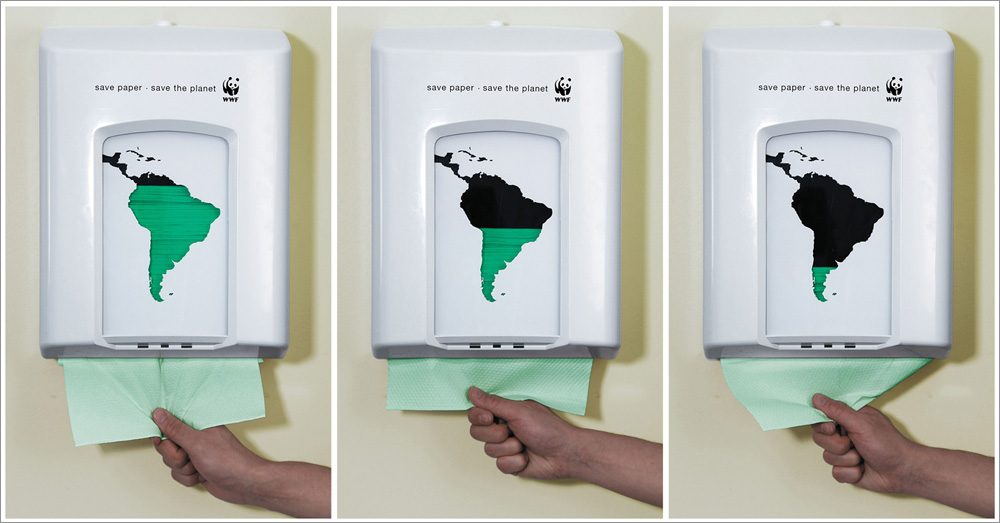
WWF Ad Campaign 1


Use only what you need....


Reusuable Designs


NetFlix uses returnable mailing envelopes, which drastically reduce the amount of paper required for customers to mail back rented DVD's. The company has mailed over one billion DVD's since its founding, so the ecological implications of that design decision are staggering.

Fedex uses a returnable envelope design that allows customers to mail their monthly payments int he same envelope that contained their bill.

Aveda designed a reusable tube continer for lipstick, made out of aluminum and a biocomposite material. After the initial purchase, customers can save money and avoid waste by purchasing make up inserts that fit into the reusable tube.